
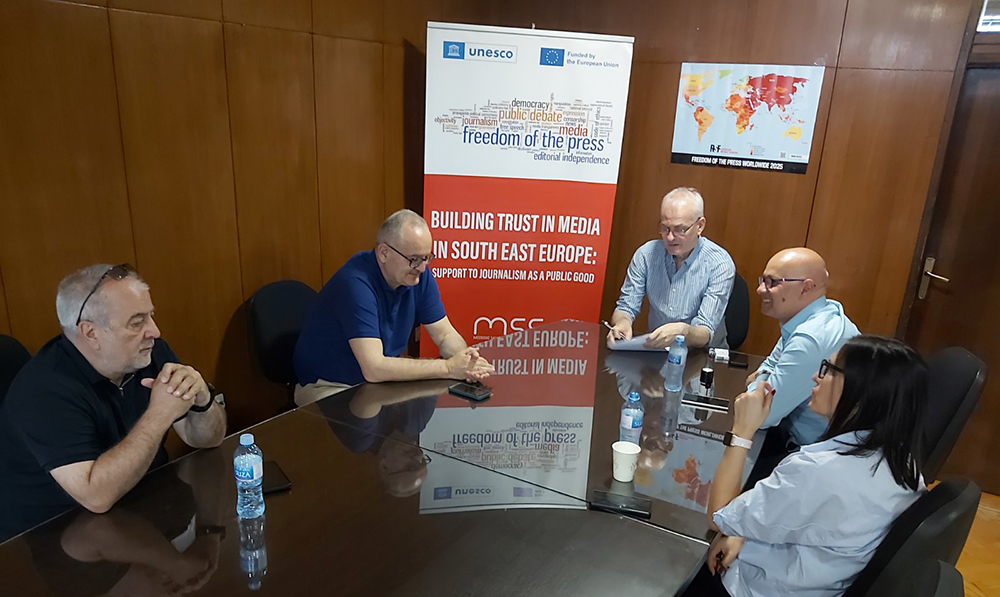
At the meeting of the Board of Directors of the Media Council for Self-Regulation, held on June 13, 2025, the results of the organization’s work over the previous six months were reviewed.
During this period, the Media Council increased its membership by 25 media outlets, so the organization currently counts 74 members. A larger membership requires more administration and more coordinated work with members.
The previous period was marked by numerous activities implemented as part of various projects. First and foremost, the work on complaints was intensified, with a significant increase in the number of complaints this year. The Complaints Commission reviewed 14 different complaints in the first half of the year.
The Media Council also participated in three studies during this period. With the support of UNESCO, a working group composed of ombudspersons from Vijesti, Monitor, Dan, and the Media Council prepared a manual on the Advantages and Risks of Using Artificial Intelligence in Journalism. The primary purpose of this manual is not only to contextualize artificial intelligence within media regulatory and self-regulatory frameworks but also to formulate guidelines to help the Montenegrin media community resolve dilemmas that arise in everyday work with AI.
Under the patronage of the OSCE’s self-regulation technical group, a manual titled Media and Social Networks in Montenegro was prepared. Its goal is to assist journalists and editors in navigating the complex media environment of social networks, as well as to develop a responsible approach to their use as sources and channels for distributing news content. Given the importance of social networks in contemporary information dissemination, the aim is to provide recommendations and clear guidelines to help journalists properly use social networks as journalistic sources and platforms for collecting and distributing information. It is important in this context to recognize and respond to challenges related to information verification. It is also crucial to understand the responsibilities and ethical standards that must be upheld on social networks, and to develop strategies to combat misinformation and harmful content online. Understanding the role and responsibility of social networks in spreading information and protecting freedom of expression is particularly important for all journalists.
Additionally, the Ranko Vujović, Executive Secretary of the Media Council participated in a larger study on the state of media freedoms in Montenegro for Columbia University in the United States.
In the past six months, the Media Council also took part in a regional campaign titled “Ethics in the Age of Artificial Intelligence,” together with other self-regulatory bodies from the Western Balkans and Turkey. This campaign aimed to raise awareness about the importance of media ethics and the role of press and media councils in applying artificial intelligence in journalism. The campaign is part of UNESCO’s project “Building Trust in Media in Southeast Europe: Supporting Journalism as a Public Good.”
Within this project, on May 19 and 20, 2025, a regional meeting of Press and Media Councils of Southeast Europe and Turkey was held in Ohrid, where a regional Declaration on the Ethical and Transparent Use of Artificial Intelligence in the Media was adopted. The discussions focused on the challenges of ethical journalism in the digital age, media sustainability, and the impact of artificial intelligence on journalism and freedom of expression. The Declaration confirms the shared commitment of all media councils that artificial intelligence should be used as support, not as a replacement for professional journalists, with clear guidelines for responsible use of these technologies.
Key principles of the Declaration include transparency in labeling AI-generated content, preserving editorial responsibility, protecting privacy and personal data, combating misinformation, and educating on AI literacy.
Executive Secretary Ranko Vujović informed attendees about the work and preparations for amending the current Journalists’ Code of Ethics. Work on this document is expected to begin soon.
The members of the Board of Directors unanimously accepted the report on completed activities and expressed support for further efforts to strengthen the organization and promote media self-regulation in our country.